

In this article, I want to explain how Electron Inter-Process Communication (IPC) works today, what problems exist in the current design and implementation, and how it could be fixed and improved.
If you already know what’s Electron IPC and how it works, you can skip to the “Problems in the current implementation” chapter where I describe the approach that can improve it.
What is Electron IPC
Electron is based on Chromium. Chromium uses a multi-process architecture. Different parts of the application run in different processes, each with its own responsibility. Electron apps are built around two main process types: one main process and one or more renderer processes.
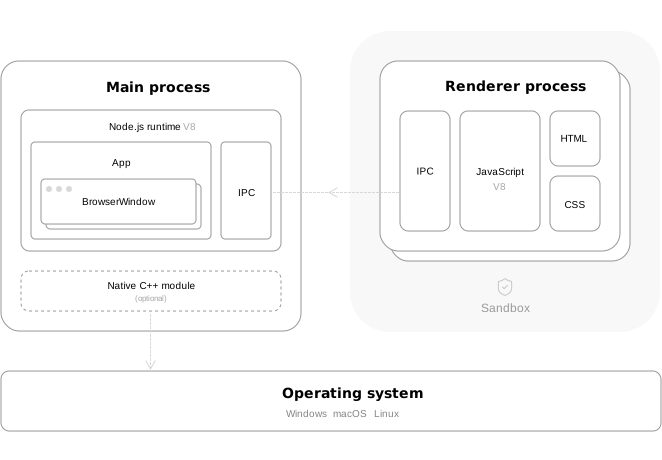
Electron process model
The renderer process is where an Electron application loads HTML, CSS, and runs JavaScript on a web page. This is where React, Vue, Svelte, or plain JavaScript code usually lives.
It runs in an isolated environment inside Chromium’s sandbox. It doesn’t have access to the local file system, cannot execute processes, and cannot use other operating-system capabilities directly. That matters for security, because an external page may include malicious code or compromised dependencies.
In the main process you can manage the application lifecycle, create windows, integrate with the operating system, and perform privileged operations that the renderer cannot do directly. This usually includes access to Node.js APIs, native dialogs, files, processes, menus, notifications, auto-updates, and other desktop-specific functionality.
I suppose you already see where this is going. Electron cannot keep all logic in the renderer process because it’s isolated. The frontend, which runs in the renderer process, often needs something that only the main process can provide. For example, the UI may need to read a file, save user settings, open a native dialog, start a background task, or ask the operating system for some information.
That is exactly why Electron needs IPC. It’s a bridge (inherited from Chromium) between the isolated frontend running in the renderer process and the privileged backend logic running in the main process. Without IPC, these two parts of the application would not be able to coordinate their work.
How Electron IPC works
There are several IPC patterns in Electron:
- Renderer to main (one-way)
- Renderer to main (two-way)
- Main to renderer (one-way)
The most important one for everyday application development is Renderer to main (two-way). This is the pattern you use when the frontend needs to ask the privileged side of the application to do something and then wait for a result.
According to the official Electron documentation, the modern way to implement this pattern is to use ipcRenderer.invoke() in combination with ipcMain.handle(). In practice, this works like a request/response call across processes: the renderer sends a request, the main process handles it, and the result comes back as a Promise.
To make that work, you usually need three pieces:
- A handler in the main process.
- A safe API exposed from Electron’s
preloadscript. - A call from the renderer process.
Let us take a look at the example from the Electron docs where the renderer asks the main process to open a native file selection dialog.
Step 1: Register a handler in the main process
In the main process, you define a function that performs a privileged operation. Then you bind that function to an IPC channel using ipcMain.handle():
const { app, BrowserWindow, dialog, ipcMain } = require('electron')
const path = require('node:path')

async function handleFileOpen() {
  const { canceled, filePaths } = await dialog.showOpenDialog({})

  if (!canceled) {
    return filePaths[0]
  }
}

function createWindow() {
  const mainWindow = new BrowserWindow({
    webPreferences: {
      preload: path.join(__dirname, 'preload.js')
    }
  })

  mainWindow.loadFile('index.html')
}

app.whenReady().then(() => {
  ipcMain.handle('dialog:openFile', handleFileOpen)
  createWindow()
})
Here, the main process listens on the dialog:openFile channel. When that channel is invoked from the renderer, Electron calls handleFileOpen(), waits for it to finish, and sends its return value back to the caller.
This highlights an important detail of Electron IPC for developers: communication is organized around string channel names. In this example, the channel name is dialog:openFile. The dialog: prefix is only a naming convention for readability. Electron does not attach any special meaning to it.
Step 2: Expose a limited API from preload
The JavaScript code in the renderer process should not call Electron internals directly. Instead, the recommended approach is to expose a narrow API from the preload script using contextBridge:
const { contextBridge, ipcRenderer } = require('electron')

contextBridge.exposeInMainWorld('electronAPI', {
  openFile: () => ipcRenderer.invoke('dialog:openFile')
})
After this, the renderer gets access to window.electronAPI.openFile().
This step is essential. The preload script acts as a controlled boundary between the isolated browser environment and Electron’s privileged APIs. The Electron documentation explicitly recommends not exposing the whole ipcRenderer object to the renderer for security reasons. Instead, the developer is expected to manually expose only the specific methods that are allowed.
Step 3: Call the API from the renderer process
Now the JavaScript frontend code in the renderer process can call the API and await the result:
const btn = document.getElementById('btn')
const filePathElement = document.getElementById('filePath')

btn.addEventListener('click', async () => {
  const filePath = await window.electronAPI.openFile()
  filePathElement.innerText = filePath
})
In the code above, when the button is clicked, the renderer does not open the native dialog by itself. Instead, it calls window.electronAPI.openFile(), which forwards the request through ipcRenderer.invoke('dialog:openFile'). Electron then finds the corresponding ipcMain.handle('dialog:openFile', ...) handler in the main process, executes it there, and resolves the Promise in the renderer process with the returned value.
At first glance, this model looks simple enough, but once your application grows and the number of channels, arguments, return values, and manually exposed preload methods starts increasing, the weaknesses of this design become much more visible. That is where the real problems of the current Electron IPC model begin.
Problems in the current implementation
A major problem with IPC in Electron is the lack of a type-safe and transparent API between processes. The developer has to manually synchronize the contract between main and renderer:
- Channel names are plain strings.
- Arguments are often passed as arbitrary objects.
- Return values have no strict schema enforced by the framework itself.
In a small “Hello, world!” application, this may look acceptable. In a real project, this becomes a maintenance problem. The main process registers handlers with names such as dialog:openFile, the preload script exposes wrappers around them, and the renderer relies on those wrappers being implemented correctly.
Electron does not provide a single source of truth that describes this API as one coherent interface. Instead, the developer has to keep several separate pieces of code in sync by hand.
This has several practical consequences:
Many mistakes are detected only at runtime. A typo in a channel name, a mismatch in argument shape, a missing field, or an unexpected return value will usually not be caught at compile time. The code may look fine to TypeScript and still fail only when a specific interaction path is executed by the user.
Refactoring is much harder than it should be. If you rename a channel, change a payload structure, or split one IPC method into two, you need to manually update the main handler, the
preloadbridge, and every renderer caller. Without a centralized contract, it is too easy to miss one of those places and introduce a hidden regression.The API between processes is not transparent enough. When you open an Electron codebase, there is usually no clear answer to a simple question: what methods are actually available from renderer to main right now? To understand that, you often have to search through
ipcMain.handle(),contextBridge.exposeInMainWorld(), andipcRenderer.invoke()calls across multiple files and mentally reconstruct the contract yourself.
As the application grows, this often turns into a chaotic set of ipcMain.handle and ipcRenderer.invoke calls without a centralized API description. The result is an IPC layer that is harder to understand, harder to evolve, and much more fragile than it should be.
In other words, the main issue is not that Electron IPC is impossible to use. The problem is that it does not scale well. It leaves too much manual coordination to the developer and provides too few guarantees that the two sides of the application actually speak the same language.
How Electron IPC can be improved
I believe Electron IPC would scale better if it were redesigned around an explicit contract instead of ad hoc string channels. One way to do that would be to define the interface between renderer and main with Protocol Buffers, generate code for both sides, and let developers work against the same API contract instead of manually coordinating low-level message passing.
Here is what that could look like in practice.
For example, the contract could be defined in a .proto file like this:
syntax = "proto3";

import "google/protobuf/empty.proto";
import "google/protobuf/wrappers.proto";

service DialogService {
  rpc OpenFile(google.protobuf.Empty) returns (google.protobuf.StringValue);
}
This file describes two things in one place:
- The exact shape of the data passed between processes.
- The exact set of methods exposed by the generated IPC API.
From there, tooling can generate JavaScript/TypeScript bindings for both the main and the renderer processes. That means the contract is no longer spread across handwritten string constants, arbitrary payload objects, and manually synchronized wrappers. It becomes a formal API definition with generated types and generated client/server stubs. This would improve type safety and discoverability, but runtime compatibility would still depend on generated code, versioning, and correct service implementation.
In the main process, the developer would implement the generated service methods like this:
import { dialog, ipcMain } from 'electron';
import { DialogService } from './gen/ipc_service';

ipcMain.registerService(DialogService({
  async OpenFile() {
    const { canceled, filePaths } = await dialog.showOpenDialog({})
    return { value: canceled ? '' : filePaths[0] }
  }
}))
And in the renderer process, the same contract would be consumed as a typed async API:
import { ipcRenderer } from './gen/ipc';

ipcRenderer.dialog.OpenFile({}).then((filePath) => {
  console.log(filePath.value)
})
Under the hood, Electron could still use its existing IPC transport mechanisms. The improvement is at the API design level: the developer would no longer work directly with raw channel names and manually shaped payloads. Instead, developers would work with a generated RPC-style interface derived from a single contract.
This approach would address the current Electron IPC problems in several ways.
- It would introduce a single source of truth. The API between renderer and main would live in the
.protodefinitions, not in scattered handler registrations and preload wrappers. If you want to know what IPC methods exist, you look at the service definitions. - It would make the IPC layer type-safe. Request and response shapes would be defined explicitly, generated into TypeScript, and checked at compile time. Many errors that are currently discovered only at runtime could be caught much earlier.
- It would make refactoring much safer. Renaming a method, changing a payload, or updating a return type would start from the contract, and the generated code would immediately show where the rest of the application needs to be updated.
- It would make the IPC API much more transparent and scalable. Instead of a growing collection of unrelated channel strings, the application would have a structured set of services and methods, which is much easier to understand as the codebase grows.
- It would reduce the amount of repetitive boilerplate developers have to write by hand. Instead of manually creating and maintaining a custom wrapper for every IPC method, much of that glue code could be generated automatically from the contract.
Conclusion
The biggest advantage of this approach is a contract-first, code-generated, RPC-like model where both sides of the application are much more likely to stay in sync. That would make Electron IPC more predictable, safer to maintain, and much more suitable for large applications.
I hope the suggested approach will be considered by the Electron team or at least discussed in the community.